

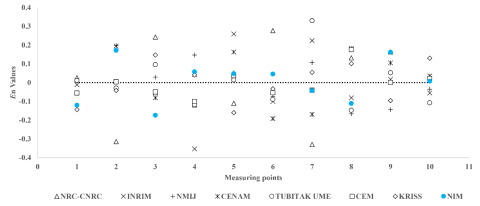
Recently, the Key Comparison Database (KCDB) of the International Bureau of Weights and Measures (BIPM) published the results of the CCL-K3.n01 international key comparison on optical polygons, conducted under the Consultative Committee for Length (CCL) of International Committee for Weights and Measures (CIPM). The National Institute of Metrology (NIM), China participated in this comparison using the position angle primary standard. The deviations between NIM’s measured values and the Key Comparison Reference Values (KCRV) were all less than 0.01″ (arcseconds), with all normalized errors (En values) below 0.18. The standard uncertainty of NIM’s measurement results for the optical polygons was 0.031″ (k=1). With those results, NIM ranked among the best-performing participating national metrology institutes.
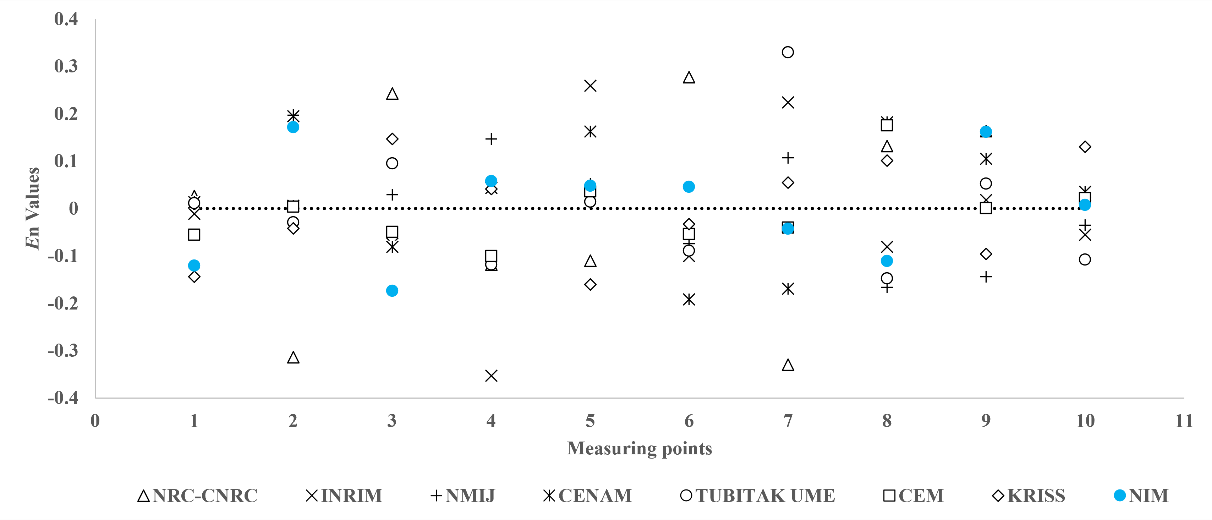
Deviations of NIM’s measured values from the KCRV
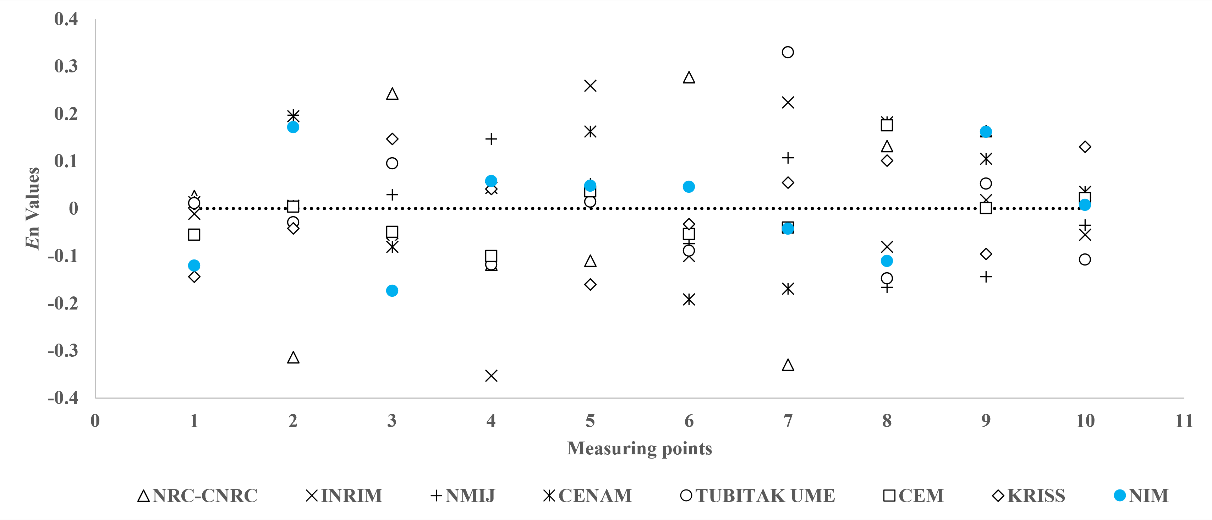
Normalized errors (En values)
The position angle primary standard is a fundamental angle-generation device in angle metrology and plays an important role in ensuring accurate angle dissemination. NIM is one of the few national metrology institutes capable of developing such a standard.
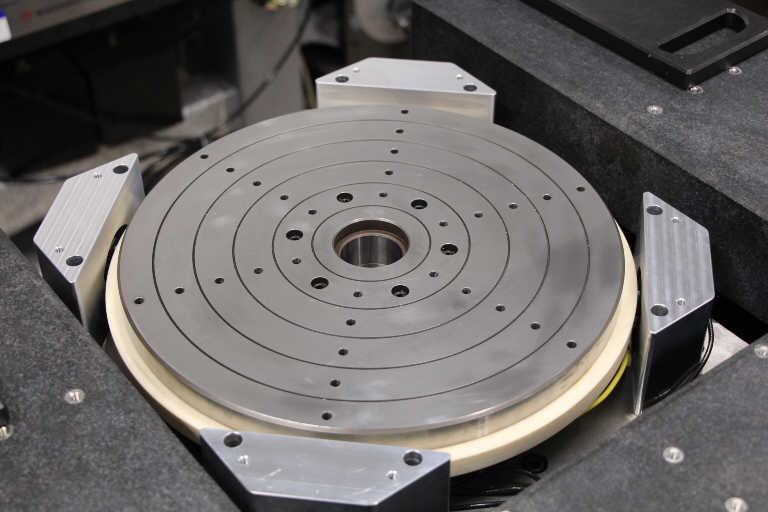
NIM’s position angle primary standard
As a key component of the National Primary Standard for Plane Angle, the position angle primary standard realizes plane-angle values through circular grating lines and provides the highest-accuracy reference for circular dividing devices such as index plates and angle encoders. It meets metrology demands in computer numerical control (CNC) machine-tool rotary positioning, aerospace vehicle attitude control, and surveying-instrument spatial orientation. The standard covers the full range from 0° to 360° with a step size finer than 0.005″, enabling cross-scale angle measurement from macroscopic to microscopic dimensions.
NIM’s position angle primary standard has long served as a national primary standard, ensuring the international equivalence of angle measurements and supporting their dissemination in China. The results of this comparison will support further improvement of NIM’s position angle primary standard and its internationally recognized calibration and measurement capabilities (CMCs), allowing it to better meet future demand for high-precision angle measurements.

 jinggongwanganbei 11010502037012